Can you get Social Security disability for Amputation?
 Written by: Scott D. Lewis, disability attorney
Yes, but not automatically, and the listing changed in 2021. Amputation is now evaluated under listing 1.20, not the old 1.05, and there are four routes. Amputation of both upper extremities at or above the wrists, or a hemipelvectomy or hip disarticulation, meets the listing on its own. The route covering one upper and one lower extremity additionally requires documentation of a need for an assistive device, or an inability to use the remaining arm for work-related movements. The route covering one or both lower extremities requires complications of the residual limb, plus documentation both that you cannot use a prosthesis and that you need a two-handed assistive device. Amputations below the wrist, such as fingers or part of a hand, are not evaluated under this listing at all, and those claims are decided on what you can still do.
If you have had an amputation, you may be eligible for Social Security disability benefits if your limitations prevent you from working. Claimants are sometimes surprised to learn that winning a disability claim based on amputation is not always straightforward.
Social Security does not automatically find a person disabled because they have had an amputation. Having a finger or toe amputated causes very different limitations from losing a foot, hand, leg, or arm, and the rules reflect that.
How amputation affects work
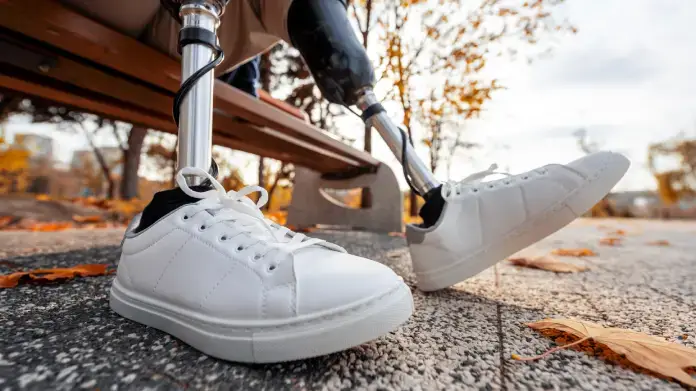
Amputation is the loss of all or part of a limb, whether through surgery, injury, or other trauma. The effects depend on which part of the body is involved.
Social Security Disability: Claim Denied?
Need Help With Application?
Don't get frustrated! At our law firm, it's our mission to professionally represent our disabled clients, as well as their families, and work hard to get you the benefits you deserve.
or Email us.
Amputations of the feet or legs typically affect the ability to walk, bend, climb stairs, and move around. Amputations involving the hands or arms typically affect the ability to push, pull, grip, and perform fine motor tasks. Many people also experience pain in and around the residual limb, including phantom limb pain, which can be limiting in itself.
Common medical reasons for amputation include:
- Diabetes, particularly where poor circulation leads to non-healing ulcers
- Peripheral arterial disease and atherosclerosis
- Arterial embolism or blood clots
- Gangrene and severe infection
- Severe frostbite
- Raynaud’s disease
- Buerger’s disease
- Cancer
- Trauma
How Social Security evaluates amputation
Amputation is addressed in the Listing of Impairments at listing 1.20, Amputation due to any cause.
If you have read about this elsewhere, you may have encountered listing 1.05. That was the old number. Social Security rewrote the musculoskeletal listings effective April 2021, and 1.20 replaced it. The criteria also changed, in ways set out below.
There are four routes, and you need only one.
1.20A: both upper extremities
Amputation of both upper extremities, occurring at any level at or above the wrists, up to and including the shoulder joint.
This meets the listing on its own, with nothing further required. Social Security also treats it as automatically satisfying the twelve month duration requirement.
Note the wording carefully. The old listing said “both hands.” The current listing says both upper extremities at or above the wrists, which is a different and more precise test.
1.20B: hemipelvectomy or hip disarticulation
Hemipelvectomy means amputation of an entire lower extremity through the sacroiliac joint. Hip disarticulation means amputation of the lower extremity at the hip joint.
Like 1.20A, this meets the listing on its own and automatically satisfies the duration requirement.
1.20C: one upper and one lower extremity
Amputation of one upper extremity at or above the wrist, together with amputation of one lower extremity at or above the ankle.
This route requires something further: medical documentation of at least one of the following three.
- A documented medical need for a walker, bilateral canes, bilateral crutches, or a wheeled and seated mobility device involving the use of both hands.
- A documented medical need for a one-handed, hand-held assistive device, such as a cane, that requires the use of your other upper extremity, or a wheeled and seated mobility device involving the use of one hand.
- An inability to use the remaining upper extremity to independently initiate, sustain, and complete work-related activities involving fine and gross movements.
The middle one is easy to overlook and is often the one that applies. If you need a cane in your remaining hand, that hand is occupied holding it, and Social Security treats the need for the device as limiting the use of both upper extremities.
1.20D: one or both lower extremities
Amputation of one or both lower extremities at or above the ankle, with complications of the residual limb that have lasted or are expected to last at least twelve months, together with documentation of both of the following: an inability to use a prosthesis, and a documented medical need for a walker, bilateral canes, bilateral crutches, or a wheeled and seated mobility device involving both hands.
This is the route most lower limb amputees are assessed under, and it is worth understanding what it turns on. The question is not whether you have a prosthesis. It is whether you can use one effectively. Residual limb complications, poor fit, skin breakdown, infection, and pain can all prevent effective use, and those complications need to be documented specifically along with the reason they persist. Note that the assistive device requirement has to be documented as well, not instead.
One timing point applies to the last two routes. Social Security requires the criteria to be present at the same time, or close enough together in the record to show the same period of severity. A file showing failed prosthesis fittings one year and a documented walker need the next may not satisfy 1.20D, even though both appear somewhere in your records.
What about fingers, toes, and partial hands?
This matters to a good number of people and is easy to miss.
Social Security does not evaluate amputations below the wrist under 1.20A, because the resulting limitation varies considerably depending on how much was lost and how it affects fine and gross movements. The same reasoning applies to toes and partial foot amputations.
That does not mean these claims fail. It means they are decided on residual functional capacity rather than by meeting a listing, and the argument is about function rather than anatomy.
If you do not meet the listing
Most amputation claims are decided at this stage. Social Security assesses your residual functional capacity, meaning what you can still do, and whether any work remains that you could perform.
Just being an amputee does not qualify you for benefits. What matters is showing that the amputation prevents you from performing functions that are important in a workplace, such as lifting, bending, walking, grasping, pushing, and pulling. How difficult that is to show depends on which limbs are involved and on the kind of work, whether sedentary, light, medium, heavy, or very heavy, that you have done before or could be expected to do.
The dominant hand point
In my experience, limited use of the dominant hand for fine and gross manipulation can be the key to a successful outcome.
If you have lost fingers on your dominant hand, you may be unable to perform the fine or gross manipulation most jobs require. This is particularly important because sedentary work, which is where claimants with lower body limitations are usually placed, depends heavily on hand use. A person who cannot stand and also cannot manipulate objects with their dominant hand has very few options left in the national economy.
Lower limb amputation and standing
With a foot or leg amputation, you may find it difficult to stand long enough to perform work that is not sedentary. At a hearing, a vocational expert may testify about what jobs, if any, exist for a person with your residual functional capacity.
Several factors weigh on the outcome: which part of the body was amputated, your work history, your age and education, and the limitations the amputation has actually placed on you. An older claimant with limited education and no transferable skills may qualify considerably more readily than a younger claimant with the same physical limitations.
Everything else counts too
Social Security must consider all of your impairments in combination. Amputation frequently comes with the condition that caused it, such as diabetes or vascular disease, and those conditions have their own effects. Phantom limb pain, depression following the loss of a limb, and back or joint problems from altered gait are all common and all relevant.
The evidence your claim needs
It is important that your medical documentation demonstrates what you cannot do and why. Useful evidence includes:
- Operative reports and records of the amputation itself
- Documentation of residual limb complications, including skin breakdown, infection, neuroma, and pain
- Prosthetic fitting records, including any failed fittings and the reasons
- Documentation of any assistive device, with the medical reason for it and the circumstances in which it is needed
- Physical and occupational therapy records
- A medical source statement addressing standing, walking, lifting, carrying, and manipulation
Doctors’ reports that set out all restrictions on your daily activities because of the amputation are valuable. Where a prosthesis has been tried and does not work for you, the record needs to say so explicitly and explain why, rather than simply noting that one was prescribed.
The duration requirement
As with any disabling condition, the effects of the amputation must have lasted or be expected to last at least twelve months.
With amputations this rarely presents a problem, since the loss is permanent. The exception is a case where you are expected to be able to use a prosthesis effectively within a year. Amputation of both upper extremities, and hemipelvectomy or hip disarticulation, satisfy the duration requirement automatically.
Talk with an Indiana disability attorney
An experienced disability attorney will know which questions to ask and how to present your case to the judge. Contact my office for a free consultation.
Most amputation claims are not won at the listing stage. They are won by showing, in detail, what the amputation stops you doing across a full working week, and by getting the residual limb complications and the failed prosthesis fittings into the record where an adjudicator will see them.
I represent Indiana residents at every stage, from the initial application through a hearing before an Administrative Law Judge.
Related Conditions: Musculoskeletal
Indiana disability attorneys